Short answer
CRM adoption succeeds when people see the CRM making their own job easier. Explain the benefits in each role’s terms, involve users in design, train by role, appoint CRM champions, measure usage and keep improving. ThoughtLogik, a UK Zoho Premium Partner, builds this adoption plan into every Zoho CRM project.
Key takeaways
- Low adoption, not the software, is the main reason CRM projects fail.
- Design the CRM around real workflows and remove anything users do not need.
- Train by role, not with one generic session.
- Track logins, data completeness and feature use, then act on what you find.
- Leaders must use the CRM themselves.
Why CRM adoption matters
A CRM only pays back when teams use it every day. With full adoption, businesses get complete customer records, reliable forecasts, automated follow-ups and less time lost to admin. With poor adoption, data goes stale, reports cannot be trusted and staff drift back to spreadsheets.
Why users resist a new CRM
- It feels like extra work on top of the day job
- Screens are cluttered with fields they never use
- They see it as a monitoring tool for management
- Training was generic, rushed or a one-off
7 strategies to improve CRM adoption
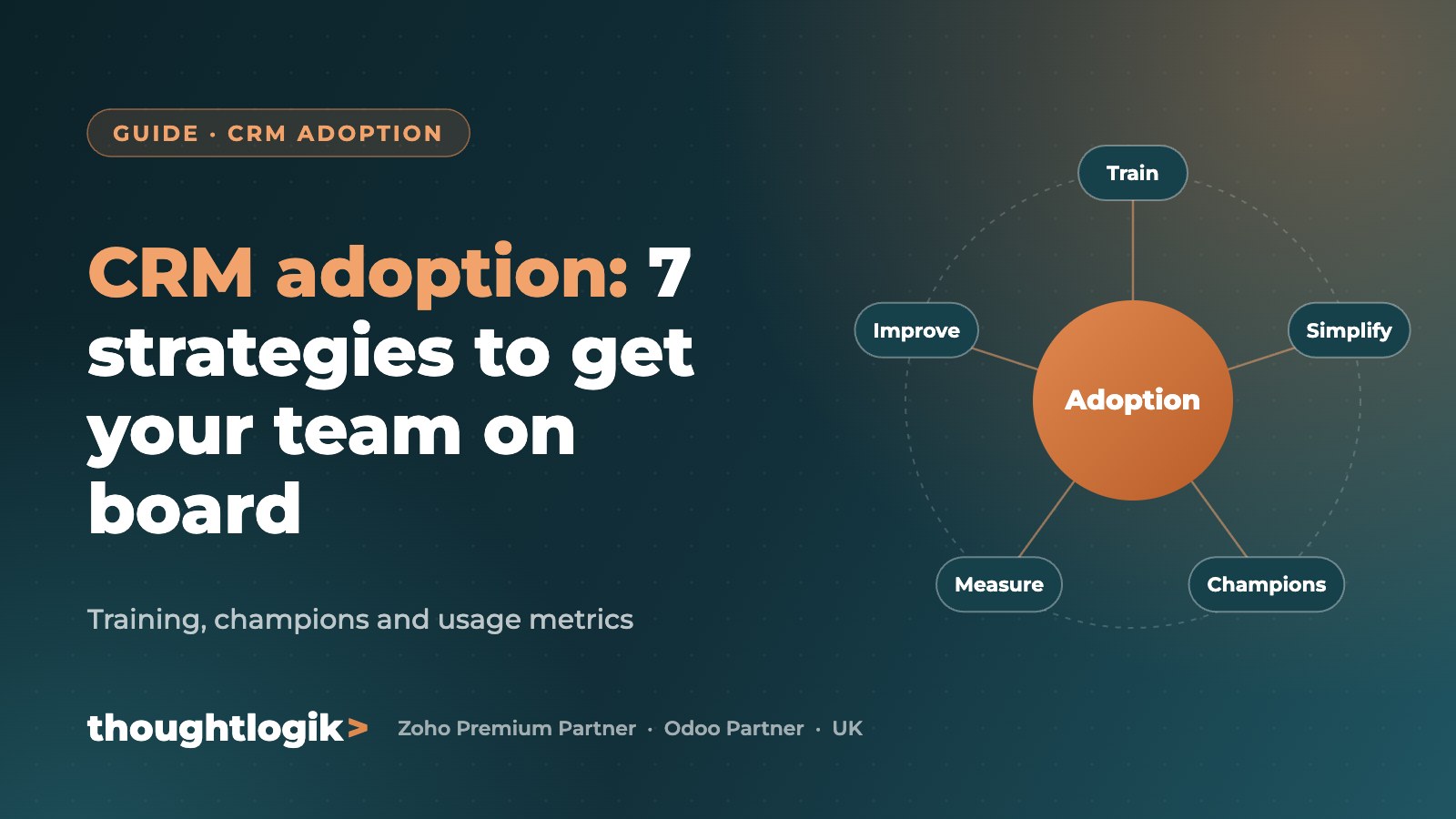
1. Explain the benefits in each role’s terms
Show sales reps how automation removes data entry, how reminders stop leads slipping, and how they can find customer history in seconds.
2. Involve users early
Include key users in design workshops and start with a pilot group to refine workflows before company-wide rollout.
3. Keep it simple
Remove unnecessary fields, tailor layouts to each role and automate repetitive steps. The easier the CRM, the more it is used.
4. Train by role
| Team | Training focus |
|---|---|
| Sales | Leads, pipeline, activities, automated follow-ups, mobile app |
| Customer service | Tickets, customer history, escalation and resolution |
| Marketing | Campaigns, segmentation, lead scoring and analytics |
| Managers | Dashboards, forecasts, coaching and data quality |
5. Mix training formats
Combine hands-on workshops, short videos, self-paced modules and quick reference guides. Use realistic, anonymised data so training mirrors real work.
6. Appoint CRM champions
Champions in each team answer questions, share tips and feed improvement ideas back to the project team.
7. Measure, feed back and improve
- Login rates: is everyone using the CRM daily?
- Data completeness: are key fields filled in consistently?
- Feature use: which tools are ignored and why?
Run regular feedback sessions, refine workflows, offer refresher training and recognise people who use the CRM well.
Leadership sets the standard
When leaders run pipeline reviews and meetings from CRM dashboards rather than spreadsheets, teams follow. Make the CRM the single source of truth for decisions.
How ThoughtLogik drives CRM adoption
Every ThoughtLogik Zoho CRM project includes user workshops, role-based layouts, automation that removes admin, tailored training and post-go-live adoption reviews. See how this worked for Morelli Group’s 50-person sales team.
Frequently asked questions
What is a good CRM adoption rate?
Aim for every intended user logging in regularly and keeping key records complete. Track adoption per team so you can target support where it is low.
How long does CRM adoption take?
Basic use usually settles within the first few weeks after go-live. Deeper adoption builds over a few months with refresher training and continuous improvement.
How do you measure CRM adoption?
Measure logins, record creation and updates, data completeness, activity logging and use of key features such as pipelines and dashboards.
Does Zoho CRM help with user adoption?
Yes. Zoho CRM supports role-based layouts, automation, mobile apps and gamification features that make the system easier and more rewarding to use.
Struggling with CRM adoption? ThoughtLogik can review your Zoho CRM, simplify it and retrain your teams. Book a free consultation or explore our Zoho CRM services.