Short answer
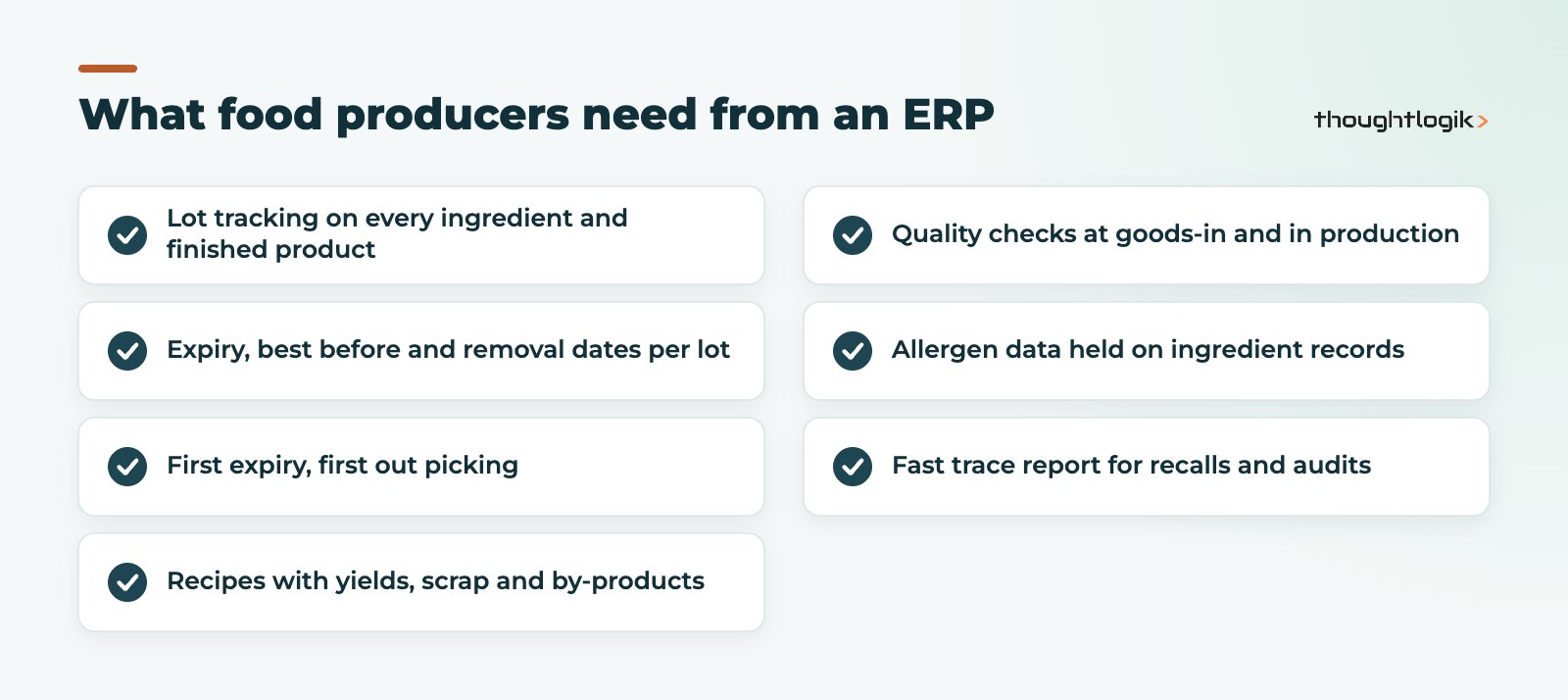
Odoo for food manufacturing covers the essentials UK food and drink producers need: recipes as bills of materials, lot tracking from ingredient to customer, expiry and best before dates with first expiry, first out picking, and quality checks at goods-in and during production. Allergen data can be held on ingredient and product records, and a traceability report shows where every batch came from and went.
Key takeaways
- Recipes are bills of materials, with support for multi-level recipes and by-products.
- Lot tracking gives food traceability one step back to suppliers and one step forward to customers.
- Odoo supports expiration, best before, removal and alert dates on each lot.
- FEFO removal ensures stock with the earliest expiry leaves first.
- Allergen data needs careful design, usually with structured fields on product records.
Food and drink manufacturers face everything other manufacturers do, plus short shelf lives, strict traceability and allergen controls. A spreadsheet can hold a recipe; it cannot tell you in minutes which customers received a batch made with a recalled ingredient. This guide explains how Odoo for food manufacturing handles those requirements, and where you need to design carefully.
What does Odoo for food manufacturing include?
There is no separate food edition. Food producers use standard Odoo Manufacturing, Inventory, Quality, Purchase and Sales, configured for batch production and lot control. Because it all shares one database, a lot number recorded at goods-in follows the product through production to the customer invoice.
Recipes as bills of materials
In Odoo, a recipe is a bill of materials. It lists ingredients and packaging with quantities for a stated batch size, and can include operations at work centres such as mixing, cooking, filling and packing. Useful features for food producers include:
- Multi-level bills of materials, so a sauce or dough made in-house becomes a component of the finished product.
- By-products, for processes that produce saleable or reusable outputs alongside the main product.
- Units of measure, so you can buy flour by the sack, use it by the kilogram and sell finished goods by the case.
- Scrap recording in production, so waste is visible rather than hidden in stock adjustments.
Version changes to recipes should be controlled; Odoo’s product lifecycle management app can manage engineering changes where you need a formal approval process. Our Odoo MRP manufacturing guide covers bills of materials in more depth.
How does Odoo for food manufacturing handle traceability?
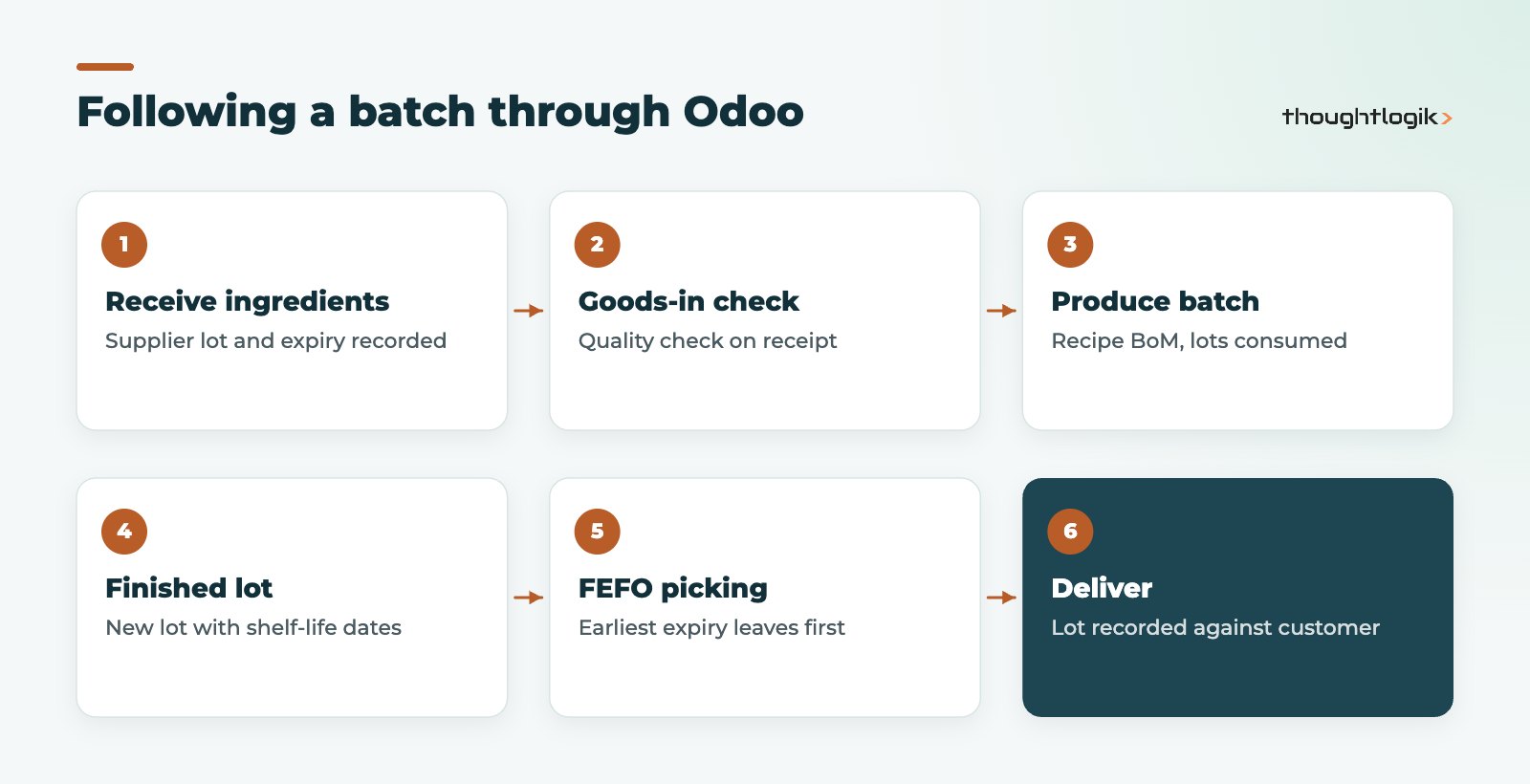
UK food law expects businesses to know who supplied them and who they supplied, often called one step back and one step forward. In Odoo, you switch on lot tracking for ingredients and finished goods. Supplier lot numbers are recorded at receipt, consumed lots are recorded on each manufacturing order, and the finished batch gets its own lot, which is recorded on each delivery.
The traceability report then shows the full chain in either direction: from a finished lot back to every ingredient lot and supplier, or from an ingredient lot forward to every batch and customer. That is the report you need in a recall or a customer audit, and it is where food traceability in Odoo pays for itself. Our Odoo lots and serials guide explains the setup.
How are expiry dates managed in Odoo for food manufacturing?
With expiration dates enabled, the Odoo expiration dates documentation describes four dates on each lot, calculated from the product’s settings:
| Date | Meaning in Odoo |
|---|---|
| Expiration date | When the goods may become unsafe and must not be used |
| Best before date | When quality starts to deteriorate, though still safe |
| Removal date | When the lot should be removed from stock |
| Alert date | When Odoo flags the lot as approaching expiry |
Expiry dates only work for products tracked by lot or serial number. Set the removal strategy on your stock locations to FEFO (first expiry, first out) so Odoo reserves the lots with the nearest expiry first. Buyers and planners should also watch alert dates to use short-dated ingredients before they become waste.
Managing allergens in Odoo
UK food law requires 14 allergens to be declared, including cereals containing gluten, milk, eggs, peanuts, tree nuts, sesame and mustard; the full list is in the GOV.UK allergen guidance for food businesses. How you hold allergen data in Odoo is a design decision. A common approach is to record allergens as structured fields on ingredient records, so they can be reviewed against each recipe and shown on specifications, labels and production documents. Custom fields are often added with Odoo Studio; see our Odoo Studio guide.
Whatever the design, Odoo for food manufacturing supports your allergen controls rather than replacing them. Your HACCP plan, supplier approval and label checks remain essential, and changes to ingredient suppliers should trigger a review of allergens on every affected recipe.
Planning production around shelf life
Short shelf lives change how you plan. Making too far ahead means finished goods lose sellable life before they ship; making too late means missed orders. When you use Odoo for food manufacturing, manufacturing orders can be generated from sales demand and reordering rules, and the expiry settings on each product tell planners how long a batch will last once made. Many producers combine make-to-order for short-life lines with make-to-stock for longer-life products, and Odoo supports both routes on the same database.
Equipment matters too. A failed chiller or oven stops a food line faster than most, so producers often pair production with preventive maintenance and cleaning schedules; our Odoo Maintenance guide covers how to plan that work around production.
Quality and hygiene checks in production
Odoo Quality lets you build checks into goods-in and production: temperature on receipt, visual inspection, weight checks, metal detection records or label verification. Failed checks can raise quality alerts with root cause and corrective actions. See our Odoo Quality guide for how control points work.
Is Odoo for food manufacturing right for your business?
Odoo for food manufacturing suits most small and mid-sized UK food and drink producers, bakeries, brewers, distillers, sauce and ready-meal makers, especially those also selling wholesale or online. Take extra care with catch-weight products sold by variable weight, complex retailer EDI and very high-speed lines with automated data capture, as these can need additional modules or integrations. Test them in a proof of concept before committing.
- Start with lot tracking and expiry dates on every ingredient and finished product.
- Run a mock recall on test data before go-live to prove the trace report.
- Agree who maintains allergen data and how changes are approved.
How ThoughtLogik helps
We implement Odoo for food and drink producers with traceability and shelf-life control designed in from the start, not added after the first audit.
- Recipe and bills of materials design, including yields and by-products
- Lot tracking, expiry dates and FEFO configuration
- Allergen data model and specification outputs
- Goods-in and production quality checks, plus mock recall testing
Frequently asked questions
Can Odoo trace a batch from ingredient to customer?
Yes. With lot tracking on ingredients and finished goods, the traceability report shows every ingredient lot used in a batch and every customer who received it.
Does Odoo handle best before and use by dates?
Odoo provides expiration, best before, removal and alert dates on lots. Map these to your own date labels and set FEFO removal so the earliest expiry leaves first.
How do I manage allergens in Odoo?
Allergen information is usually held as structured fields on ingredient and product records, reviewed against recipes and shown on specifications and labels. Design this carefully and keep your HACCP controls in place.
Is Odoo suitable for small food businesses?
Yes. Smaller producers can start with Inventory, Manufacturing and lot tracking, then add Quality, Maintenance and eCommerce as they grow.
Can you trace a batch in minutes? We will set up Odoo so you can. Book a free consultation or see our food and drink solutions.