Short answer
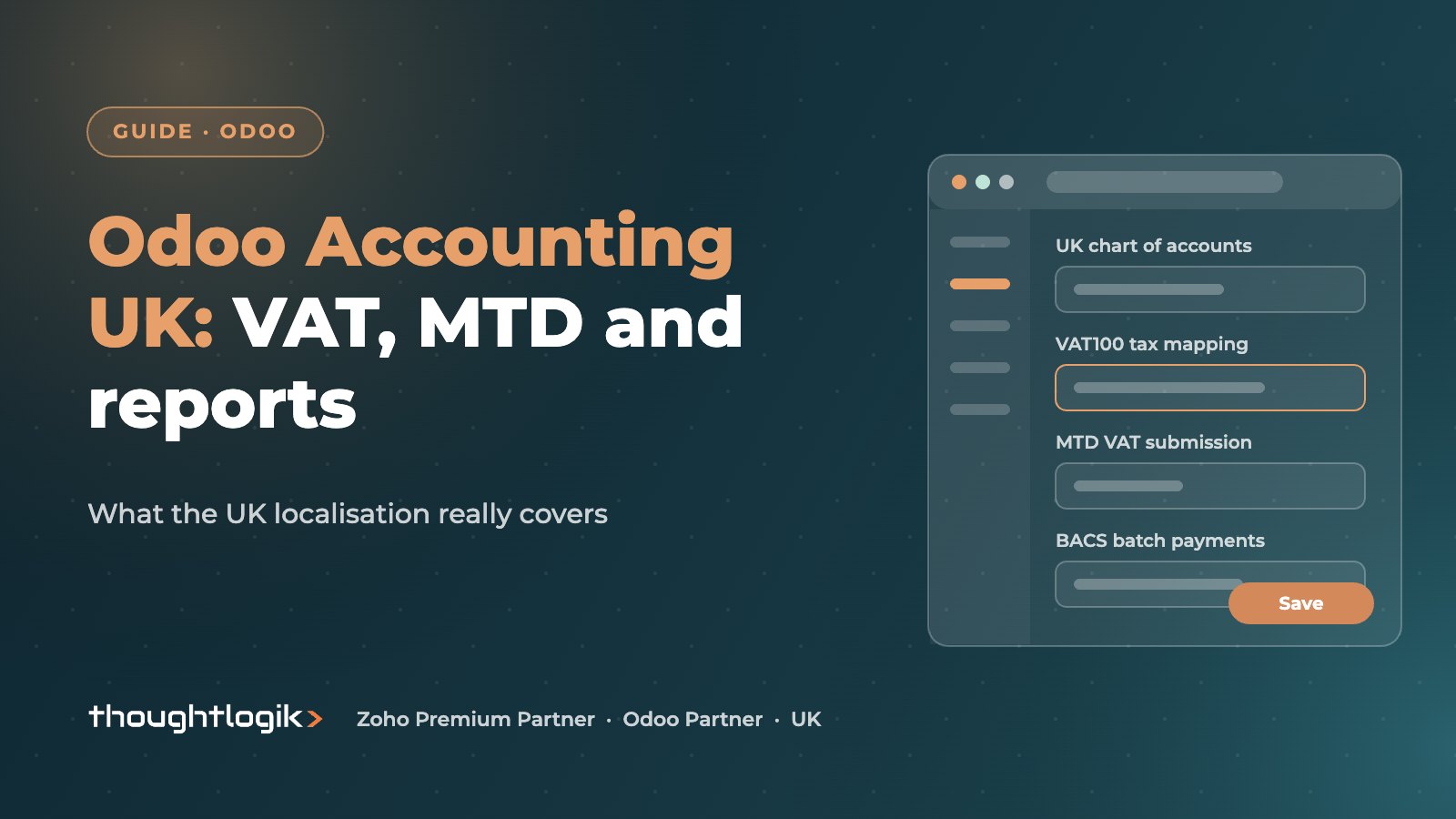
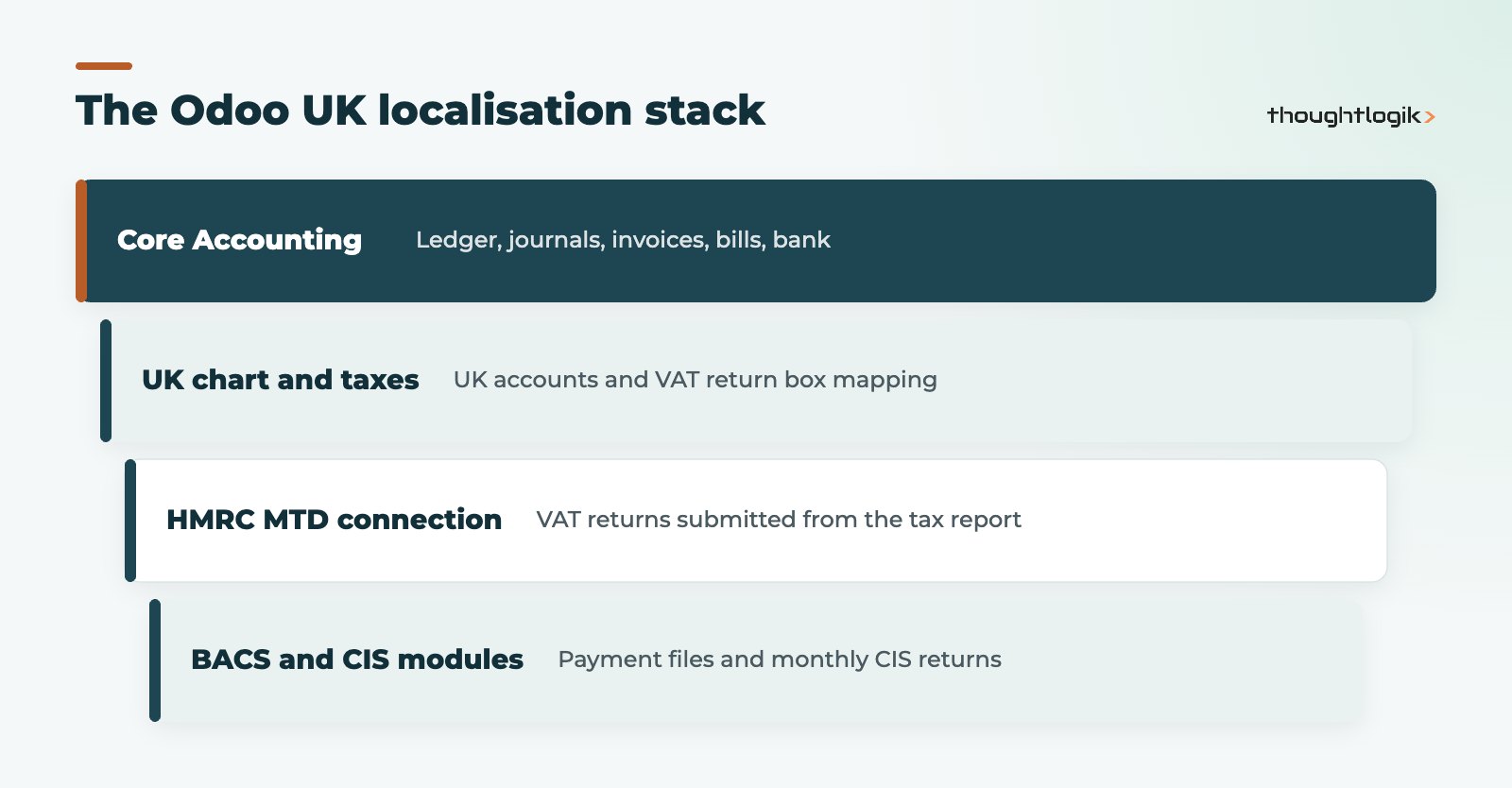
Odoo Accounting UK readiness comes from the UK localisation: a UK chart of accounts, a VAT tax structure that maps to the VAT return boxes, and a Making Tax Digital connection that submits VAT returns to HMRC from the tax report. Add-on UK modules cover BACS payment files and Construction Industry Scheme returns. For most VAT-registered SMEs it replaces a standalone bookkeeping package, with the benefit that sales, purchasing and stock post straight into the ledger.
Key takeaways
- The UK localisation installs a UK chart of accounts and VAT taxes that feed the VAT return.
- MTD VAT returns are submitted to HMRC from Odoo’s tax report once you connect your HMRC account.
- Separate UK modules handle BACS files and CIS monthly returns.
- UK payroll is not run inside Odoo Accounting; plan a payroll connector or separate payroll software.
- The full Accounting app is an Enterprise feature; Community covers invoicing only.
Finance leaders evaluating Odoo Accounting UK usually ask the same three questions. Will it handle UK VAT and Making Tax Digital properly? Will my accountant be comfortable with the reports? And what does it not do? This guide answers all three based on how the UK localisation works today and what we see on real projects.
What does Odoo Accounting UK localisation include?
When you create a company with a UK address, Odoo installs the UK fiscal package. According to the Odoo United Kingdom localisation documentation, the core modules are:
| Module | What it does |
|---|---|
| UK – Accounting | A UK chart of accounts ready for corporation tax reporting and a VAT tax structure aligned to the VAT100 return |
| UK – Accounting Reports | The UK tax report, including the Making Tax Digital VAT connection |
| UK – HMRC API | The underlying connection to HMRC |
| UK BACS Payment Files | BACS files for supplier batch payments and customer direct debits |
| UK – Construction Industry Scheme | CIS deductions and monthly CIS returns |
This Odoo UK localisation gives you a sensible starting point, not a finished ledger. Most businesses still adjust the chart of accounts to match how they report to the board and their accountant.
Odoo VAT and Making Tax Digital
Making Tax Digital for VAT applies to every VAT-registered business in the UK, so this is the first thing to check. In Odoo, VAT is driven by tax records on each invoice and bill line. Each tax is mapped to the boxes on the VAT return, so the tax report fills itself from posted transactions.
How do you submit an MTD VAT return from Odoo Accounting UK?
Open the tax report under Accounting, Reporting. The first time, you use the Connect button to authorise Odoo with your HMRC credentials. After that, Odoo retrieves your open VAT obligations, you review the figures, and you submit the return from the same screen. A few practical points from the documentation and our own projects:
- Only open obligation periods can be submitted, so keep your periods and lock dates tidy.
- In a multi-company database, each company authorises separately and the credentials are reset between submissions.
- Always review the tax report and supporting journal items before you submit. Odoo sends what the ledger says.
Our dedicated guide to Odoo and Making Tax Digital goes deeper into VAT schemes, lock dates and year-end checks.
Paying suppliers and collecting by BACS
Odoo Accounting UK users handle BACS payments through the UK BACS module. You add your Service User Number, then create batch payments for suppliers and generate the BACS file for your bank. On the customer side, you can record BACS Direct Debit Instructions and collect by direct debit, which is useful for subscription and recurring billing. For many UK SMEs, BACS payments were the main reason they kept a separate bank upload process; in Odoo it becomes part of the payables run.
CIS for construction businesses
Contractors can mark subcontractors as CIS in the contact record, apply the correct deduction rate on bills, and prepare the monthly CIS return from the tax return menu. Odoo can also send a monthly reminder. If you work in construction, check the configuration with your accountant, because getting subcontractor status wrong affects every payment.
Which reports will your accountant use?
Odoo Accounting includes the standard statutory and management reports your accountant expects, all drillable down to the journal item:
- Profit and loss and balance sheet, with comparison periods
- General ledger, trial balance and partner ledger
- Aged receivables and aged payables
- Cash flow statement and executive summary
- Tax report for VAT
Because sales, purchasing, stock and expenses all post into the same ledger, month-end is less about importing data and more about reviewing it. Reconciling the bank is the other big month-end task; see our guide to faster Odoo bank reconciliation.
Setting up Odoo Accounting UK: a practical checklist
A clean Odoo Accounting UK setup follows a predictable order. Skipping steps is the most common reason a first VAT return looks wrong.
- Confirm the company details. UK address, VAT number and fiscal year end, so the right localisation and periods apply.
- Review the chart of accounts. Map your existing nominal codes to Odoo accounts and remove what you do not need.
- Check every Odoo VAT tax. Standard, reduced, zero-rated, exempt, reverse charge and imports should each point at the correct return boxes.
- Load opening balances. Import the trial balance and open receivables and payables at the cut-over date.
- Connect the bank and set up BACS payments. Add bank feeds or statement imports and your Service User Number.
- Run a parallel VAT period. Compare Odoo’s tax report with your old system before the first live submission.
If you are coming from Sage, most of the effort is in the mapping and the opening balances rather than the software itself. Our Sage to Odoo migration guide covers that cut-over in detail.
What Odoo Accounting UK does not cover out of the box
Being clear about gaps saves pain later.
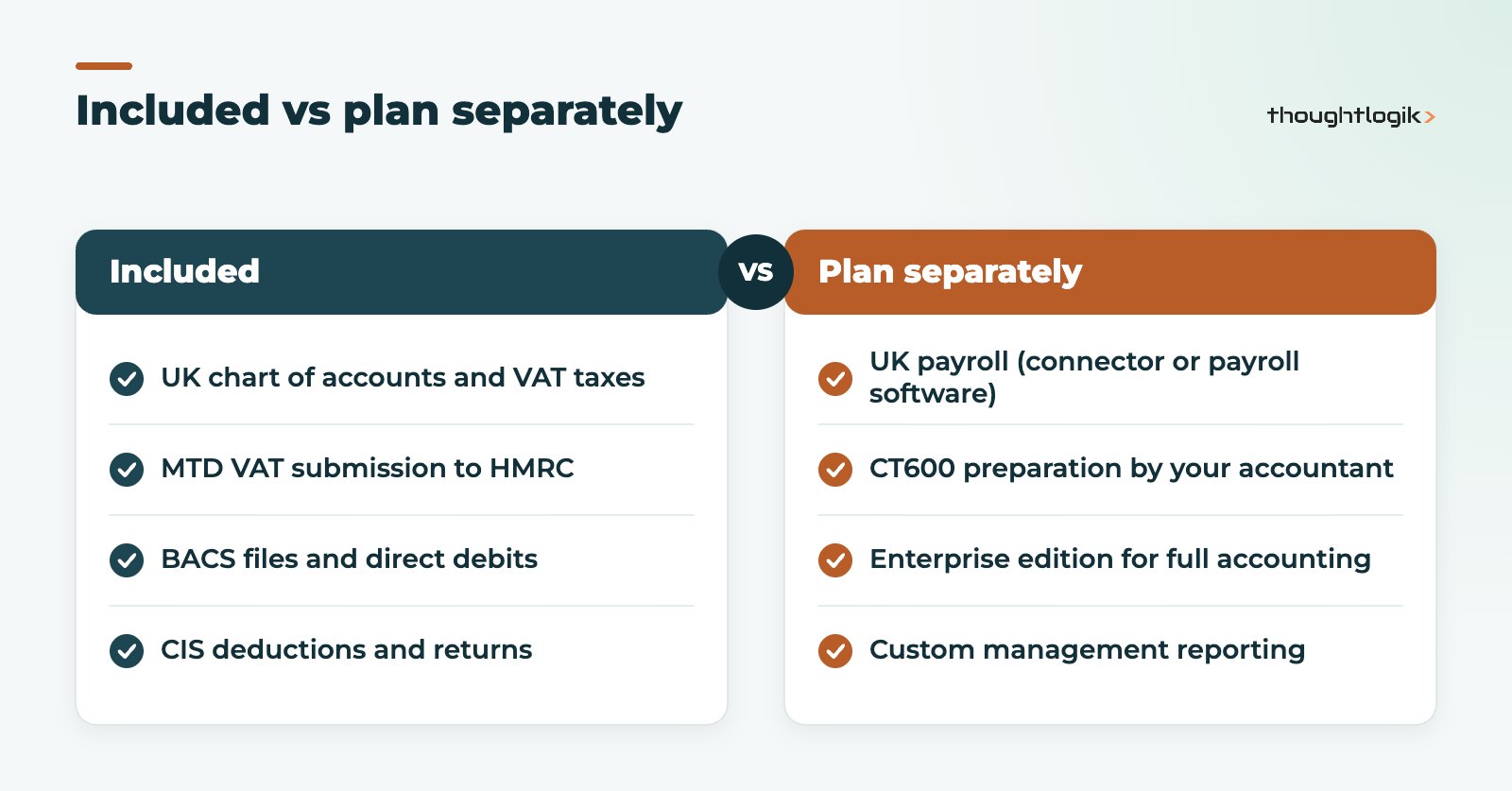
- UK payroll. Odoo’s UK documentation points to a payroll connector (Employment Hero) rather than native UK payroll. Read our guide to Odoo payroll in the UK for the options.
- Corporation tax returns. The chart of accounts supports corporation tax reporting, but the CT600 itself is usually prepared by your accountant.
- Edition. Full accounting (bank reconciliation, financial reports, MTD) is in Odoo Enterprise. Community is mainly invoicing. See Odoo pricing in the UK for how editions and plans work.
Is Odoo Accounting UK a replacement for Xero or Sage?
For businesses that only need bookkeeping, a dedicated package may be enough. Odoo makes sense when you also want stock, manufacturing, CRM or eCommerce posting into the same ledger. We compare the two approaches in Odoo vs Xero.
How ThoughtLogik helps
ThoughtLogik is a UK Odoo Partner that sets up Odoo finance for VAT-registered SMEs and groups.
- Chart of accounts and VAT mapping reviewed with your accountant.
- Opening balances, historical data and MTD connection tested before go-live.
- BACS, CIS and multi-company configuration where relevant.
- Training for finance teams on month-end in Odoo.
Frequently asked questions
Is Odoo Accounting UK recognised for Making Tax Digital for VAT?
Odoo submits VAT returns to HMRC through the MTD VAT API from its tax report. Check HMRC’s list of compatible software for the current position before you rely on any product.
Does the Odoo UK localisation handle the VAT flat rate or cash accounting schemes?
These schemes need specific tax configuration and a review with your accountant. We configure and test them case by case rather than assume the defaults fit.
Can Odoo run UK payroll?
Not natively in the UK. Most businesses use a payroll connector or dedicated payroll software and post payroll journals into Odoo.
Can we keep our existing chart of accounts in Odoo Accounting UK?
Yes. You can import or adapt your existing chart, as long as the VAT tax mapping and control accounts are set up correctly.
Moving your finance function to Odoo? We will review your VAT, reporting and payroll needs before you commit. Book a free consultation or see our Odoo implementation service.