Short answer
Your Odoo implementation cost is driven by scope (how many apps and processes), data migration, customisation, integrations, hosting and the internal time your team gives the project. Licences are a separate, published per-user subscription, so the variable part is the implementation work. Controlling scope and customisation is the most effective way to keep the budget predictable.
Key takeaways
- Licence fees and implementation services are separate budget lines.
- Scope and customisation move the Odoo implementation cost more than anything else.
- Some needs (Studio, multi-company, external API, Odoo.sh or on-premise) require Odoo’s Custom plan.
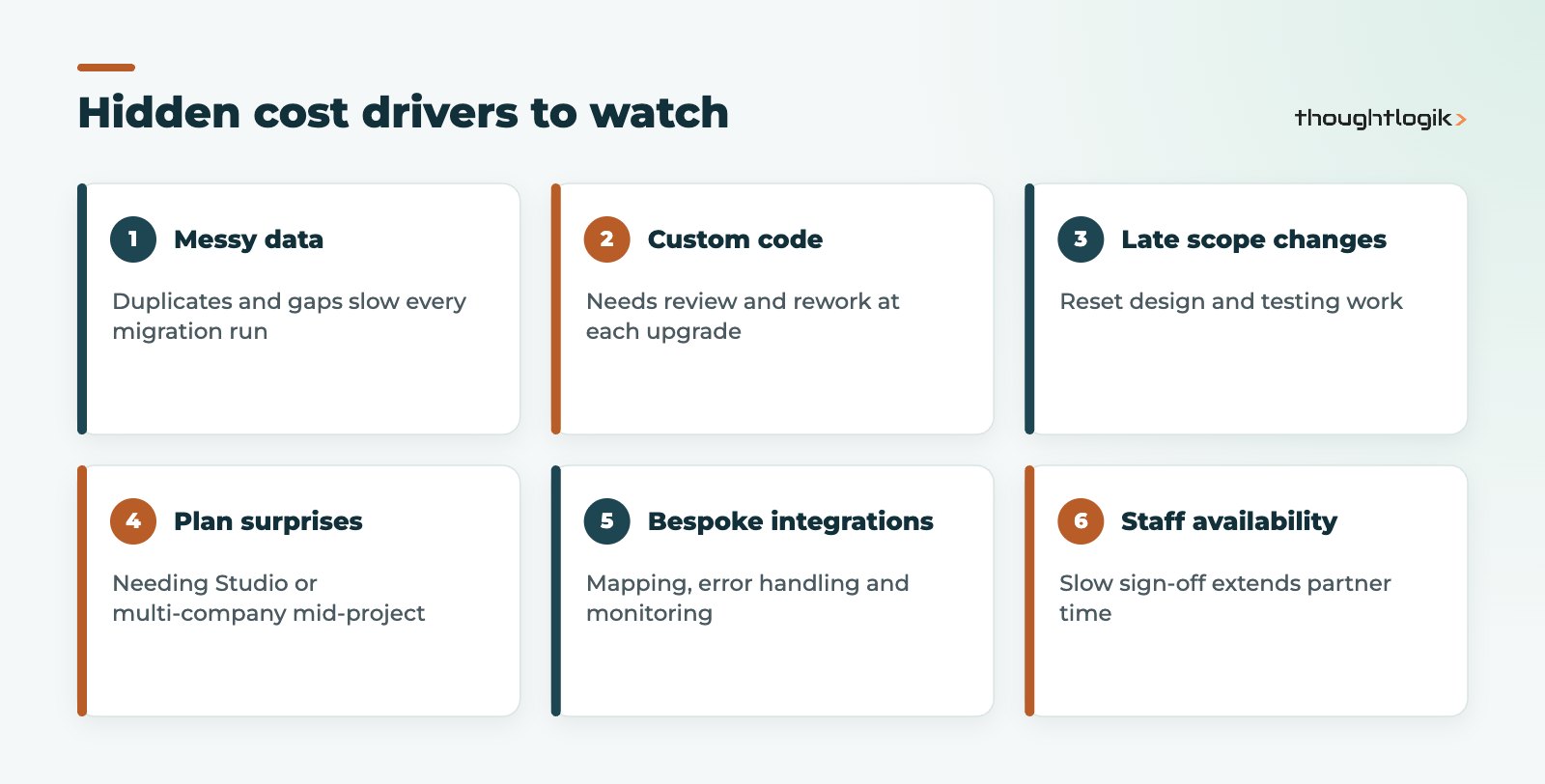
- Data quality and integrations are frequent hidden cost drivers.
- Total cost of ownership includes support, upgrades and your own staff time.
Most buyers start by asking for a single number. We do not publish implementation prices, because two businesses with the same headcount can need very different projects. What we can do is explain exactly what moves the figure, so you can shape the project and compare proposals properly.
What makes up an Odoo implementation cost?
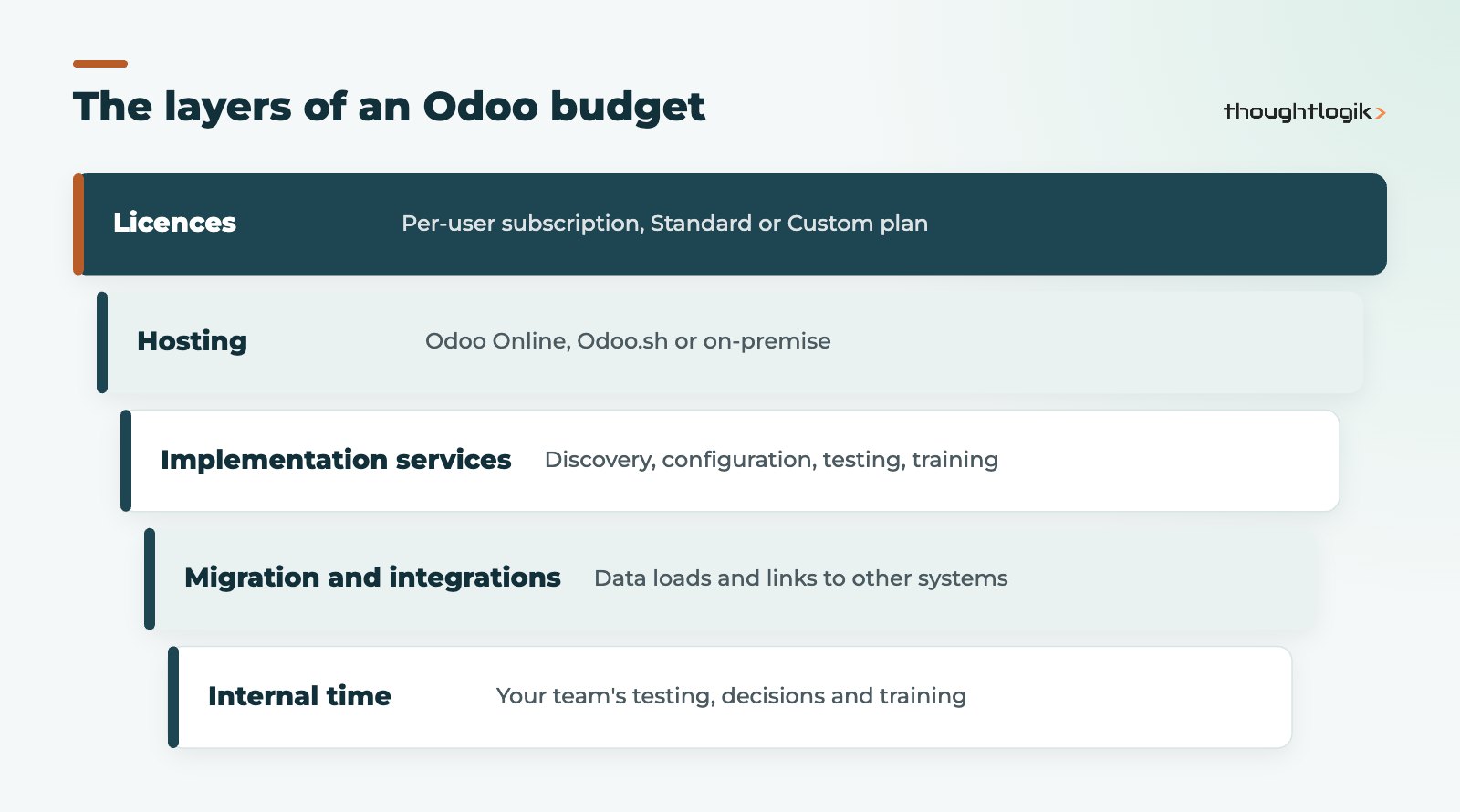
Think of the budget in layers. Licences are the visible part; the implementation work underneath is where estimates differ.
How much does Odoo cost in licences?
How much does Odoo cost before any services? Odoo publishes its subscription pricing per user, by plan, and it changes from time to time, so check the current figures rather than relying on old articles. Our Odoo pricing for UK businesses page explains the plans. The Odoo licence cost depends on user numbers and plan, not on how many apps you use within a plan.
When does the Odoo Custom plan apply?
The plan choice affects both licence and implementation. Studio, multi-company, access to the external API, and hosting on Odoo.sh or on-premise are tied to the Odoo Custom plan. If your project needs any of these, budget for the Custom plan from the outset rather than discovering it mid-build. Hosting also matters: Odoo Online needs no server work, while Odoo.sh and on-premise add deployment, monitoring and backup responsibilities that someone has to own and budget for. Odoo lists what each plan includes on its official pricing page.
The seven factors behind an Odoo implementation cost
| Factor | Lower effort | Higher effort |
|---|---|---|
| Scope | A few standard apps | Full ERP across finance, stock, manufacturing and service |
| Process fit | Adopt standard Odoo flows | Unusual processes needing changes |
| Customisation | Configuration only | Custom modules and reports |
| Data migration | Clean master data, open items only | Years of history, messy or duplicate records |
| Integrations | Standard connectors | Bespoke links to EDI, logistics or legacy systems |
| Structure | One company, one warehouse | Multiple companies, currencies or sites |
| Change management | Small, engaged team | Many users across locations |
Scope and process fit
Every app you add needs design, configuration, testing and training. Odoo’s standard flows cover a great deal, and businesses that accept them spend less. Our guide to customisation vs configuration explains where the line usually falls.
Customisation
Custom code is the cost driver that keeps costing. It needs specifying, building and testing now, then reviewing at each version upgrade. Ask of every change: is this a real business need, or a habit from the old system?
Data migration
Moving open invoices and master data is one thing; moving years of transaction history is another. Cleaning data before the project starts lowers your Odoo implementation cost directly.
Integrations
Ecommerce, payroll, EDI, carriers and banking feeds each need mapping, error handling and testing. Standard connectors are cheaper than bespoke ones. Ask whether each integration will be built, bought as an existing connector, or run through a middleware tool, because each option carries different build and running costs. Also agree who monitors failed syncs once you are live.
Company structure and multi-site operations
One company with one warehouse is the simplest shape. Each extra legal entity brings its own chart of accounts, tax setup, intercompany rules and reporting, and each extra warehouse brings routes, locations and stock counts to design and test. Multiple currencies add revaluation and bank setup. None of this is unusual for Odoo, but every element is work, and it should be visible in any estimate. Our guide to Odoo multi-company explains the setup choices.
Training and change management
Training is often trimmed to fit a budget, and that is a false saving. Users who do not understand the new process create workarounds, bad data and support tickets that cost more later. Budget for role-based training, a short set of written procedures for key tasks, and time for super users to support colleagues in the first weeks. The number of users, their locations and how different their roles are all influence this line.
Testing
User acceptance testing needs your people, not just the partner’s. Budget their time explicitly: a finance lead who spends two days testing the month-end close saves far more than two days of fixes after go-live.
What is Odoo total cost of ownership?
Odoo total cost of ownership is wider than the project budget. Over several years it includes:
- Subscription licences as users grow
- Hosting, if you choose Odoo.sh or your own servers
- Support and small enhancements after go-live
- Version upgrades, where custom modules add effort
- Internal staff time for testing, training and administration
A lean, standard setup keeps Odoo total cost of ownership low because upgrades stay simple. Heavily customised databases carry that cost at every new release.
Support models vary. Some businesses want a monthly allowance of hours for questions and small changes; others prefer to call on help as needed. Upgrades are the other long-term line: Odoo releases a new major version each year, and although you do not need to upgrade every year, older versions eventually fall out of support. A database close to standard is quicker to move forward. Our Odoo upgrades service covers planning for this.
How can you reduce your Odoo implementation cost?
- Start with a paid discovery. A fixed discovery gives you a scope and estimate based on facts, not assumptions.
- Phase the project. Go live with the core first. Our Odoo implementation timeline guide shows how phasing works.
- Challenge every customisation. Configure first, customise only where there is a clear return.
- Clean your data early. Archive what you do not need to migrate.
- Commit internal time. Delays on your side extend partner time too.
Comparing Odoo implementation cost proposals
When proposals differ widely, the scope usually differs too. Check each covers the same apps, the same migration depth, testing, training and post go-live support, and ask how change requests are priced. Our guide on how to choose an Odoo partner lists the questions to ask.
How ThoughtLogik helps
We scope projects in detail before quoting, so your budget reflects your real processes rather than a generic package.
- Structured discovery with a clear scope and assumptions
- Configuration-first design to limit custom code
- Phased plans that spread effort and deliver value sooner
- Transparent change control during the project
Frequently asked questions
How much does Odoo cost to implement?
It depends on scope, data, customisation and integrations. A partner should give you an estimate after discovery, not before understanding your processes.
Is the Odoo licence cost included in implementation?
No. Licences are a subscription paid to Odoo; implementation is the partner’s services. Budget for both separately.
Why do Odoo implementation cost quotes vary so much?
Usually because the proposals assume different scope, migration depth or customisation. Compare like for like.
Does Odoo Community avoid licence costs?
Community has no subscription fee but lacks several Enterprise apps and features, so the gap is often filled with extra development, which moves cost from licences to implementation and maintenance.
Do I need the Odoo Custom plan?
If you need Studio, multi-company, the external API, or Odoo.sh or on-premise hosting, yes. Otherwise the Standard plan may be enough.
Want a budget built on your real scope? Talk to us about a structured discovery. Book a free consultation or see our Odoo implementation service.