Short answer
Most Odoo implementation problems come from people and process, not the software: unclear ownership, scope creep, copying old processes into Odoo, poor data migration, too little testing and weak user adoption. You avoid them by agreeing scope and owners early, configuring before customising, rehearsing data migration, testing real scenarios and investing properly in training.
Key takeaways
- Odoo projects usually fail on decisions and discipline, not on missing features.
- A named internal owner with authority is the single strongest success factor.
- Scope creep and heavy customisation push up cost and risk together.
- Rehearse data migration at least once before the real cut-over.
- User adoption needs role-based training and a firm switch-off of old tools.
Odoo is a capable platform used by businesses of every size. Yet we regularly speak to UK SMEs whose Odoo project has stalled, gone over budget or gone live and disappointed. When we review these projects, the causes are strikingly consistent, and almost none of them are software faults. This article sets out the common Odoo implementation problems and what to do about each.
Why do Odoo implementations fail?
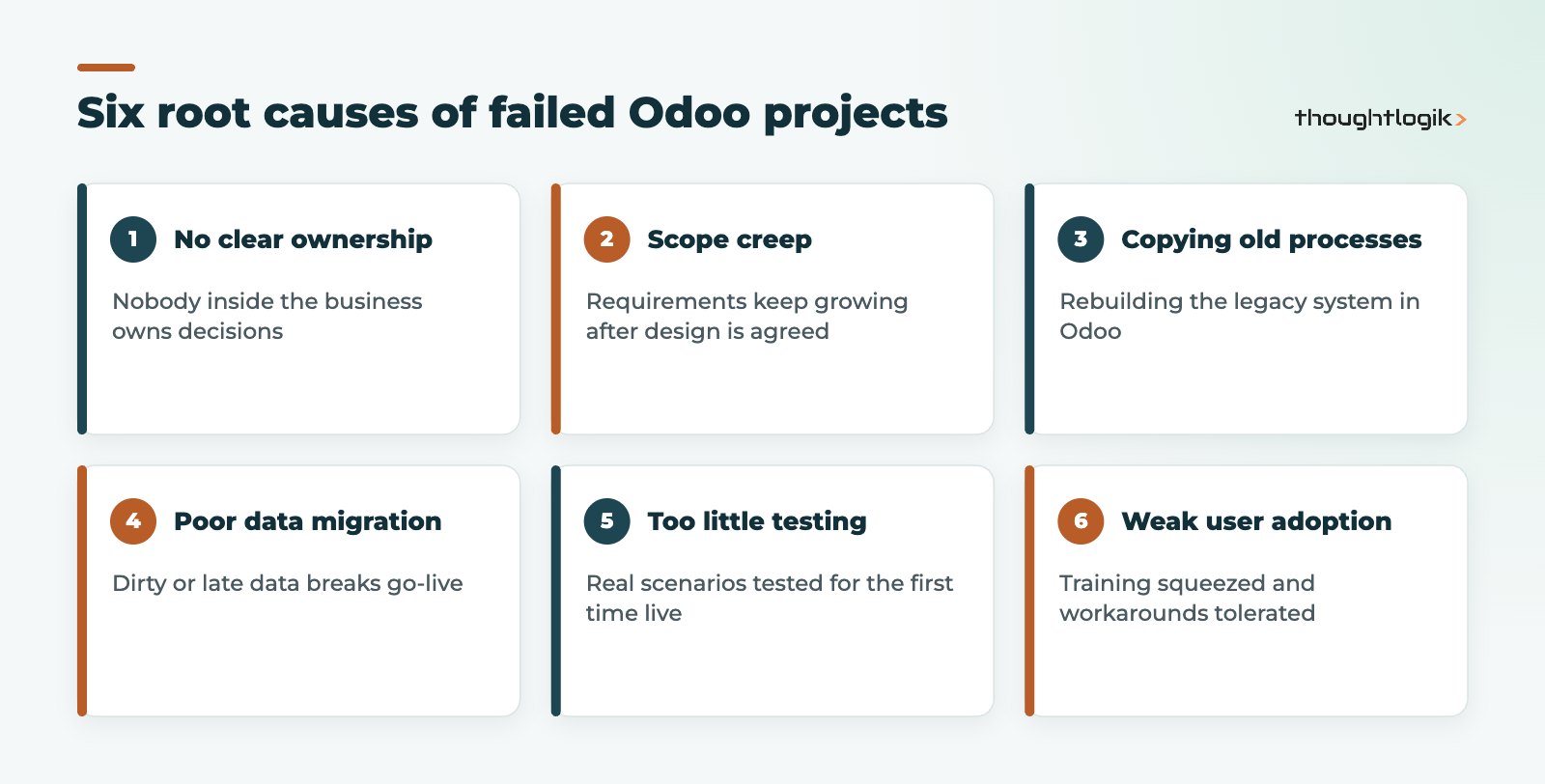
An ERP implementation changes how a whole business works. Odoo makes that change more affordable than many older systems, but it does not remove the need for clear decisions, clean data and trained people. The grid below shows the root causes we see most often.
1. Nobody inside the business owns the project
If the project is “IT’s job” or “the partner’s job”, decisions stall. Someone senior needs time and authority to make trade-offs, and each department needs a process owner who signs off how their area will work. Without that, Odoo implementation problems pile up as unanswered questions.
2. Scope creep
Scope creep is gradual: one more report, one more approval, one more integration. Each looks small, but together they delay go-live and add cost. Agree a phase one scope, put later wishes on a phase two list, and use a simple change process so every addition has a visible cost and an owner.
3. Rebuilding the old system in Odoo
Many projects try to recreate every screen and habit of the previous system. That leads to heavy customisation, which makes upgrades harder and support slower. Challenge each requirement, and use Odoo’s standard processes wherever they meet the business need. Our article on Odoo customisation vs configuration explains how to decide.
4. Poor data migration
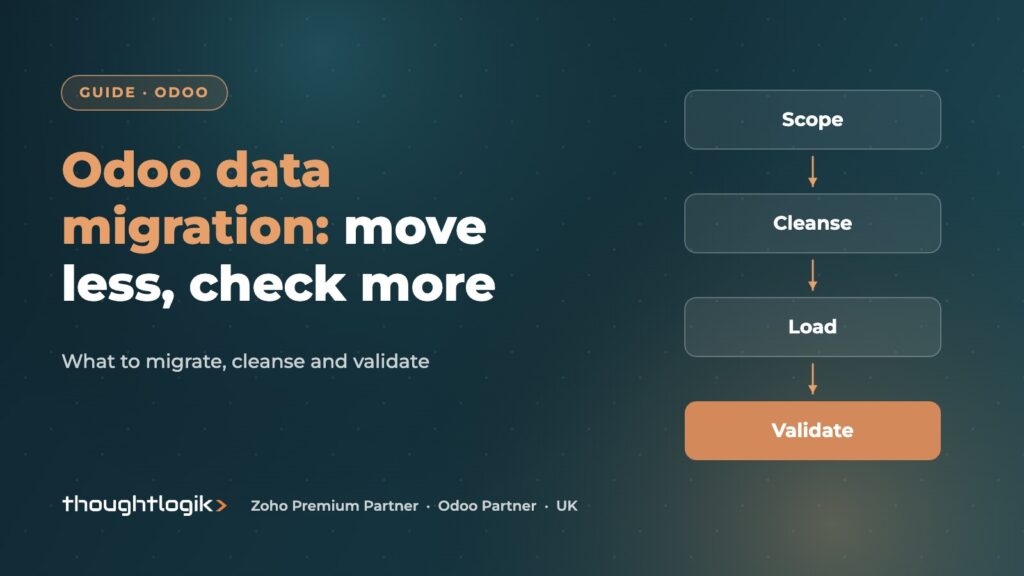
Data migration is routinely underestimated. Duplicate customers, inconsistent product codes and unreconciled balances cause immediate problems after go-live. Start cleansing early, decide what history you really need, and run at least one trial migration that finance reconciles before the real cut-over. See our Odoo data migration guide.
5. Too little testing
Testing individual screens is not enough. Users need to run full scenarios, such as quote to cash, purchase to pay and month-end close, with realistic data. Scenarios that are tested for the first time on go-live day are where the worst surprises appear.
6. Weak user adoption
If training is squeezed into the final week, people fall back on spreadsheets. User adoption needs role-based training on each person’s own tasks, quick-reference guides, super-users in each team and a firm date when old tools are switched off.
Which Odoo implementation problems are specific to UK businesses?
Some issues come up particularly often in UK projects:
| Area | Typical problem | How to avoid it |
|---|---|---|
| VAT and MTD | Tax set-up not matched to how the business trades | Configure the UK localisation carefully and test a VAT return before go-live |
| Payroll | Assuming Odoo will run UK payroll | Plan HMRC-recognised payroll software and a payroll journal from the start |
| Opening balances | Balances loaded that do not match the old ledger | Agree a cut-over date with your accountant and reconcile trial balances |
| Bank feeds and payments | Payment and reconciliation processes left until late | Include bank reconciliation and supplier payment runs in testing |
Odoo’s UK localisation documentation describes the country-specific accounting set-up. For payroll, see our guide to Odoo payroll in the UK.
Early warning signs of Odoo implementation problems
Odoo implementation problems rarely appear overnight. Watch for these signals during the project, because each is much cheaper to address early:
- Workshops are regularly cancelled or attended by people who cannot make decisions.
- The list of “must have” customisations keeps growing after design sign-off.
- Data cleansing has not started a few weeks before the planned trial migration.
- Testing is described as “the partner will test it”.
- Go-live is fixed to a date, whatever the state of readiness.
If two or more of these sound familiar, pause and reset the plan. In any ERP implementation, moving a go-live date by a few weeks costs far less than fixing live Odoo implementation problems while customers are waiting.
How to avoid Odoo implementation problems
Prevention is far cheaper than rescue. These are the practices we see in successful projects.
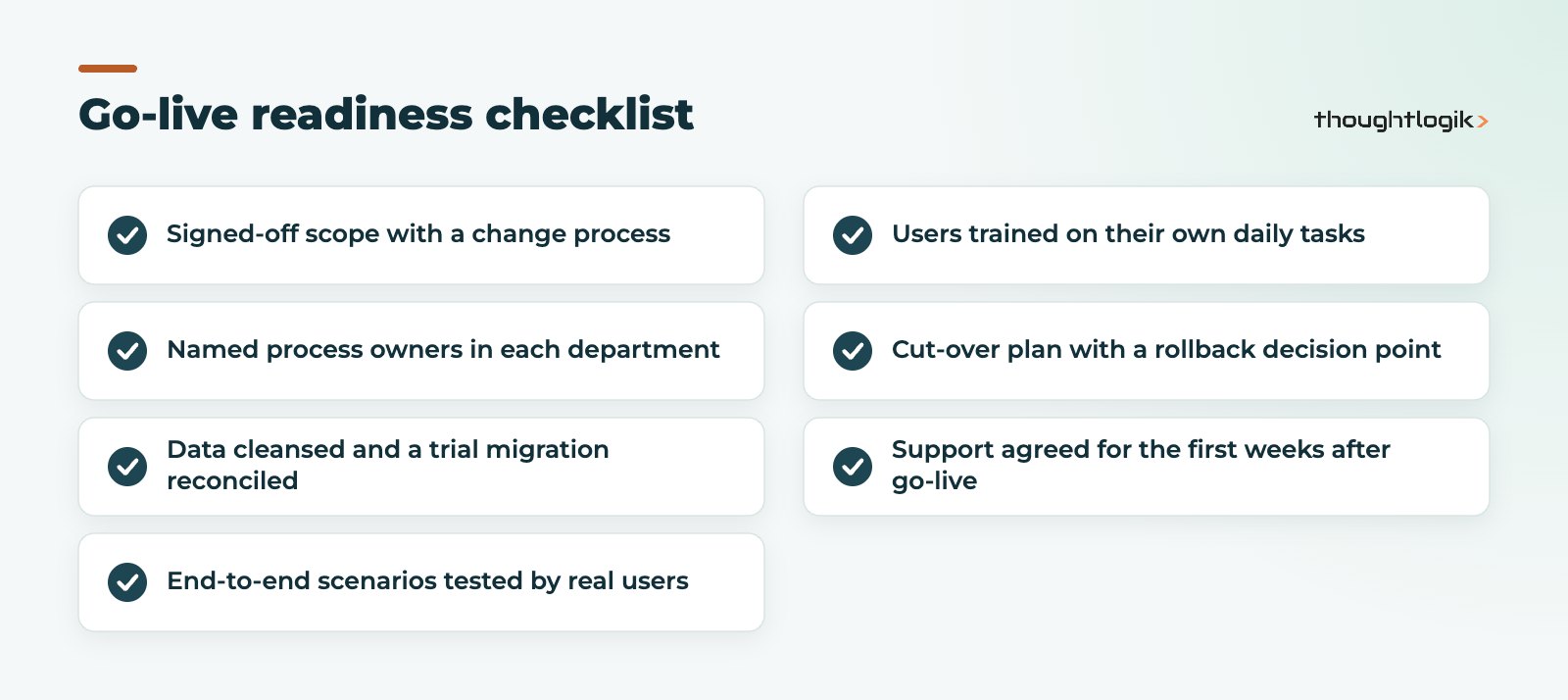
- Define outcomes before features. Write down the three to five business results the project must deliver, and test every design decision against them.
- Phase the rollout. Go live with core processes first, then add further apps once the business is stable.
- Configure first, customise last. Use standard Odoo and Studio before custom code.
- Protect people’s time. Key users need real time for workshops, testing and training, not whatever is left after the day job.
- Rehearse the cut-over. Trial migrations, reconciliation and a go or no-go meeting reduce go-live risk dramatically.
- Plan post go-live support. The first weeks after go-live are when most questions arise. Have support ready before you need it.
Realistic timelines matter too. Our Odoo implementation timeline guide explains what drives project length.
What if your Odoo project is already in trouble?
If you are part-way through a troubled ERP implementation, or live but unhappy, the fix usually starts with an honest review rather than more development. We typically look at:
- Which processes work, which are worked around and why.
- The volume and quality of custom code, and whether standard Odoo now covers it.
- Data quality in key areas such as customers, products, stock and open balances.
- Whether users were trained on the processes they actually run.
From there, a short stabilisation plan targets the problems that cost most, before any new features are added.
Does the choice of Odoo partner matter?
Yes. A good Odoo partner challenges requirements, explains trade-offs plainly and puts senior people on design decisions. Ask how they handle scope changes, testing and data migration, and speak to their existing clients. Our guide on how to choose an Odoo partner lists the questions to ask.
How ThoughtLogik helps
ThoughtLogik is a UK Odoo Partner with teams in Northampton and Coimbatore. We deliver new projects and rescue struggling ones, with a method designed to prevent the usual Odoo implementation problems.
- Fit-gap analysis and a phased, agreed scope.
- Configuration-first design with controlled customisation.
- Rehearsed data migration and structured user acceptance testing.
- Role-based training and post go-live support, as set out in how we deliver.
Frequently asked questions
What is the most common cause of Odoo implementation problems?
In our experience, unclear ownership and decision-making inside the business. When nobody has the authority and time to make decisions, scope drifts and timelines slip.
Can a failed Odoo implementation be rescued?
Usually, yes. A structured review identifies what to keep, what to simplify and what to fix first. Starting again from scratch is rarely necessary.
How much user training is enough?
Enough that each user can complete their own daily tasks unaided before go-live. Role-based sessions using your own data work far better than generic demonstrations.
Should we go live with all Odoo apps at once?
Not always. A phased rollout, starting with core processes such as sales, stock and accounting, reduces risk for many SMEs. The right approach depends on how tightly your processes connect.
Odoo project not delivering what you expected? We will give you an honest view of what to fix first. Book a free consultation or see our Odoo implementation services.